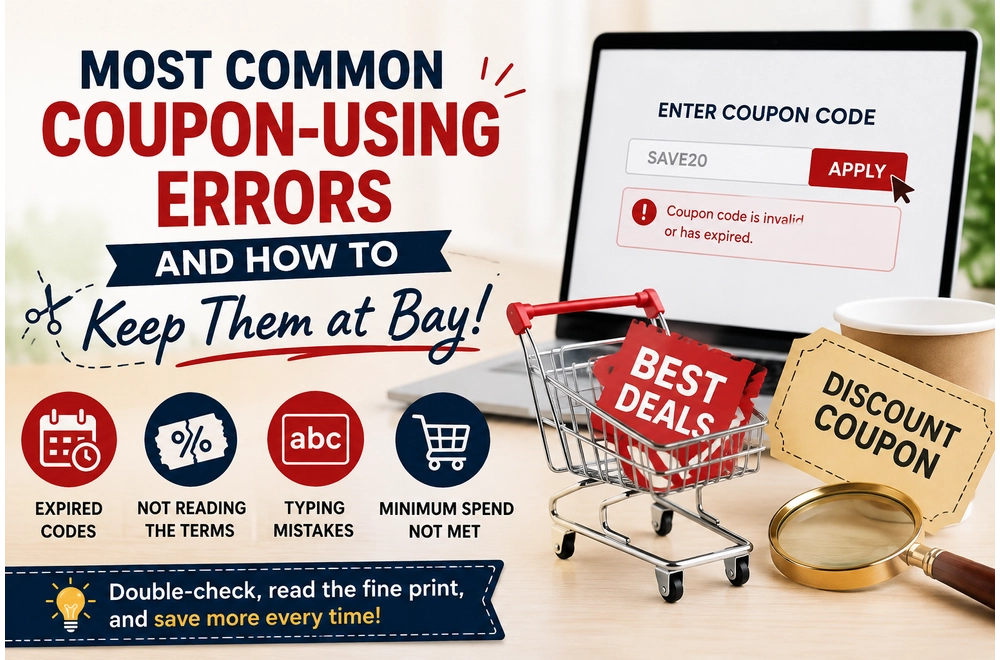
The most common coupon mistakes are entering a code that has already expired, missing the minimum spend needed for a discount code, or trying to use a coupon on an item that isn’t included in the offer. Another issue is assuming that two or more coupons can be used on the same order when the store only accepts one. 1st order deals are also complicated because they’re usually offered only to new customers. It’s nice to check the details mentioned on the coupon. If you are still not sure, then reach out to the brand’s customer support to avoid the most common coupon mistakes at checkout.
Top Summary
If you regularly shop online in Australia, these practical couponing tips can save you from the most common checkout headaches.
Before adding items to the cart, check the expiry date on the coupon.
Note the exceptions mentioned by the retailer.
See to it that the discount code applies to the products you want.
Check whether another promotion or automatic sale gives you a better final price.
Include delivery, surcharges and other unavoidable costs in your calculation.
Don’t assume two coupon codes can be stacked.
Save screenshots or records of important promotion terms when appropriate.
This guide is meant for all Australian consumers who like to save on their shopping through the use of discount codes. The purpose of this guide is to enable people to identify coupon using errors, find out why the coupon does not work, and, most importantly, teach how to use coupons correctly and effectively without making every shopping experience a complicated calculation process.
Check out this 2026 Black Friday shopping guide for Australia and find genuine deals.
What are the most common coupon mistakes?
The most common coupon mistakes usually are using old vouchers and not reaching the assigned purchase cost. Normally, they aren't technical problems. In everyday life, what happens is: a shopper finds a promising code, gets excited about the discount, fills the cart with products & checks the conditions after the code fails.
This will demotivate you from using coupons in the future.
For instance: A coupon may be valid but restricted to 1st-time customers. It may require $100 spend before GST, exclude sale items, or apply only to a particular product category. The retailer's terms are what ultimately determine whether the offer applies.
Australian consumer guidance also recommends checking voucher expiry dates, blackout periods and the specific conditions attached to offers.
Here's the thing: a 20% coupon isn't automatically a good deal.
If your $90 order becomes $72 after the code but adds $15 delivery, you're really paying $87. If another retailer sells the same item for $82 with free delivery, the “20% off” option isn't necessarily the cheaper purchase.
That distinction matters.
Read our guide on best Cyber Monday deals in Australia in 2026.
1. Using an expired coupon code
This is probably the easiest mistake to make. Coupon pages can remain online after an offer has ended, while shoppers may save old codes in notes, browser bookmarks, or emails and forget when they expire.
Coupon expiry mistakes are especially common around short promotional campaigns. I recommend checking the expiry date immediately before checkout, particularly when you're shopping during fast-moving sales periods.
Don't assume that because a code appears on a coupon website, it's still valid. Retailers can change or end promotions according to their own terms.
Learn why coupon codes don’t work and how to troubleshoot common issues before completing your purchase.
2. Missing minimum-spend requirements
“10% off” sounds straightforward until the fine print says “minimum spend $150”. I’ve seen this catch shoppers who are only a few dollars short. But adding something you don't need just to unlock a discount can defeat the whole point of saving.
For example, imagine you're buying a $135 order and have a coupon requiring $150 spend for $20 off. Adding a $20 item gets you to $155, but you've still spent more than you originally planned.
Actually, let me rephrase that: the coupon can be useful if you already needed the extra item. It isn't useful if the discount persuades you to buy something you wouldn't otherwise have purchased. That's one of the biggest differences between coupon hunting and genuine saving.
Check our online shopping Australia guide and know important things before digital shopping.
3. Ignoring product or brand exclusions
Some codes work across a retailer's website. Others don't. A promotion might exclude clearance products, selected brands, gift cards, subscriptions, marketplace products or already-discounted items.
And this is where shoppers often think, “The code is broken.” It might not be. The code may simply not apply to the product sitting in your cart. Australian discount-voucher guidance says businesses should clearly state conditions and restrictions, including restrictions involving particular products, businesses, times or expiry dates.
Find the best time to use deals in Australia to maximise your savings.
Why does my coupon code not work?
A coupon code can fail because it's expired, restricted to certain products or customers, subject to a minimum spend, limited to particular dates, already redeemed, incorrectly entered, or incompatible with another promotion.
Look at the checkout message first. If it says “not valid for selected products,” don't immediately try five random codes. Check the eligible products. If it says “minimum spend not reached,” look at the qualifying subtotal rather than simply the amount shown in your cart.
And if there's no useful explanation, check the retailer's current promotion terms.
Here's my basic troubleshooting order:
Check the spelling and capitalisation of the code.
Check the expiry date.
Check the minimum spend.
Check product and brand exclusions.
Check customer restrictions.
Check whether another code is already active.
Refresh the cart and re-enter the code.
Compare the final price without the code.
That last step is important. Sometimes the code isn't the best deal. Get the 10 best electronic deals in Australia.
How can I use coupons correctly?
You can use the coupons correctly by checking their expiry date, minimum spend, exclusions, stacking criteria, and final price before checkout. Learning how to use coupons correctly is less about collecting hundreds of codes and more about checking a few important details before you buy.
I use a simple five-question test:
Does the coupon apply to what I'm buying?
Has it expired?
Is there a minimum spend?
Can I combine it with another offer?
What's my final delivered price in AUD?
If I can answer those five questions, I'm usually in a much better position to decide whether the promotion is worthwhile. Explore the best electronic stores to use the latest coupon codes.
Coupon mistake checklist
Coupon error | Why it happens | What to do |
Expired code | Old promotions remain searchable | Check the current expiry date |
Minimum spend missed | Conditions are overlooked | Check qualifying subtotal |
Excluded product | Brand/category restrictions | Read exclusions before checkout |
Code entered incorrectly | Copy-and-paste or typing errors | Re-enter carefully |
Multiple codes attempted | Stacking isn't always permitted | Check the retailer's terms |
Delivery ignored | Shopper focuses on percentage discount | Compare final delivered price |
Sale price overlooked | Coupon becomes the focus | Compare coupon and automatic sale |
Unplanned spending | Discount creates urgency | Stick to your shopping list |
Explore these Australian gift ideas for every occasion and recipient.
What coupon budgeting mistakes should I avoid?
Avoid budgeting mistakes by doing shopping based on discounts alone, excessive use of coupons, buying things you don’t need, and considering taxes, fees, and coupon expiry dates. One of the sneakiest problems isn't the coupon itself. It's the psychology around it. Coupon budgeting mistakes happen when a discount makes me spend more than I planned. For example, I might see “Spend $200, save $40” and start looking for another $65 worth of products to unlock the offer.
That's not automatically wrong. If I already need those products, great. But if I'm buying $65 of stuff because I don't want to “miss” $40, I've changed the purpose of the coupon. I like to think of coupons as a shopping trolley, not a shopping destination. A trolley helps me carry what I already need; it shouldn't convince me to walk through every aisle.
So before using a high-threshold promotion, I ask myself: Would I buy this product without the coupon? If the answer is no, I don't count the avoided $40 as savings.
Maintain your clothing budget by following these latest spring fashion trends.
What are the best couponing tips for Australian shoppers?
The first most useful couponing tips are shop from a list and check the retailer's current terms. Lastly, compare the final price. I also recommend paying attention to Australian shopping cycles.
During Black Friday, Cyber Monday, Boxing Day and major end-of-season sales, retailers may run several overlapping promotions. That can make coupon conditions harder to follow because a code might be limited to selected products or excluded from an existing promotion.
Don't rush just because a banner says “ends tonight”. If you're buying an expensive item, take a minute to compare the final price, delivery terms, and return conditions.
Find out coupon codes that actually work in 2026.
What should I check before clicking “Pay now”?
Before paying, check that the coupon is applied to the product you are buying. I use this final checkout checklist:
Coupon: Is the code actually applied?
Discount: Has the expected amount been deducted?
Products: Are all qualifying products included?
Minimum spend: Have I met the correct threshold?
Delivery: Has the shipping cost changed?
Fees: Are there additional unavoidable charges?
Payment: Does the selected payment method change the price?
Terms: Does the promotion have any remaining restrictions?
Total: Is the final AUD amount what I expected?
If the numbers don't make sense, I stop. That's much easier than discovering the problem after payment. Use coupons on AliExpress, but before that, check is AliExpress safe or not.
How Can You Save More With Discount Codes?
Learning how to save more with discount codes starts with comparing the whole offer rather than collecting as many codes as possible.
Start by identifying the product you already intend to purchase. Then compare the available discount against the retailer's sale price, delivery offer, and other applicable promotions.
A few practical strategies include:
Compare percentage and fixed-value discounts.
Check whether free shipping provides a larger overall saving.
Look for current seasonal promotions.
Avoid buying unnecessary products to meet a coupon threshold.
Check whether a sale price and coupon can legally or technically be combined.
Compare the final checkout price before completing the order.
Use a coupon only when it supports a purchase you already planned to make.
The most effective couponing strategy is not necessarily using the highest number of promotions. It is choosing an offer that reduces the actual cost of a planned purchase.
Check out our complete guide on the top 10 women's clothing brands.
Coupon Budgeting Mistakes vs Better Practices
Coupon Budgeting Mistake | Better Practice |
Buying extra products to unlock a discount | Compare the extra spending with the actual saving |
Choosing an expensive product because it has a coupon | Compare final prices across suitable products |
Assuming a larger percentage means a better deal | Calculate the actual dollar saving |
Ignoring delivery charges | Include shipping in the final cost |
Using every coupon you find | Use coupons only for planned purchases |
Treating the discount as money saved before checkout | Calculate savings after considering total spending |
Choosing a coupon without comparing alternatives | Compare available promotions before paying |
Find the best Australian fashion trends and avail them while maintaining your budget.
Conclusion
The biggest common coupon mistakes aren't complicated. They're usually expired codes, overlooked restrictions, minimum-spend traps, unnecessary purchases, and failure to check the final delivered price. And once you know what to look for, they're much easier to avoid.
I don't think good couponing means chasing every discount available. It means finding a discount that fits a purchase you're already making and checking whether the final price is genuinely worthwhile.
So before your next Australian online purchase, pause for 30 seconds.
Honestly, that's often all you need to turn coupon hunting from a frustrating guessing game into a much more reliable way to shop. Visit Anniepromo for the latest coupons & deals.