What Does DRM-Free Gaming Mean? A Beginner’s Guide
Published On
BY Sarah
About the Author
Sarah is a shopping and savings expert who researches brands, verifies deals, and creates practical buying guides. Her goal is to help readers make informed purchasing decisions while finding genuine discounts and offers.
Browse GOG discount codes and buy DRM-free PC video games!
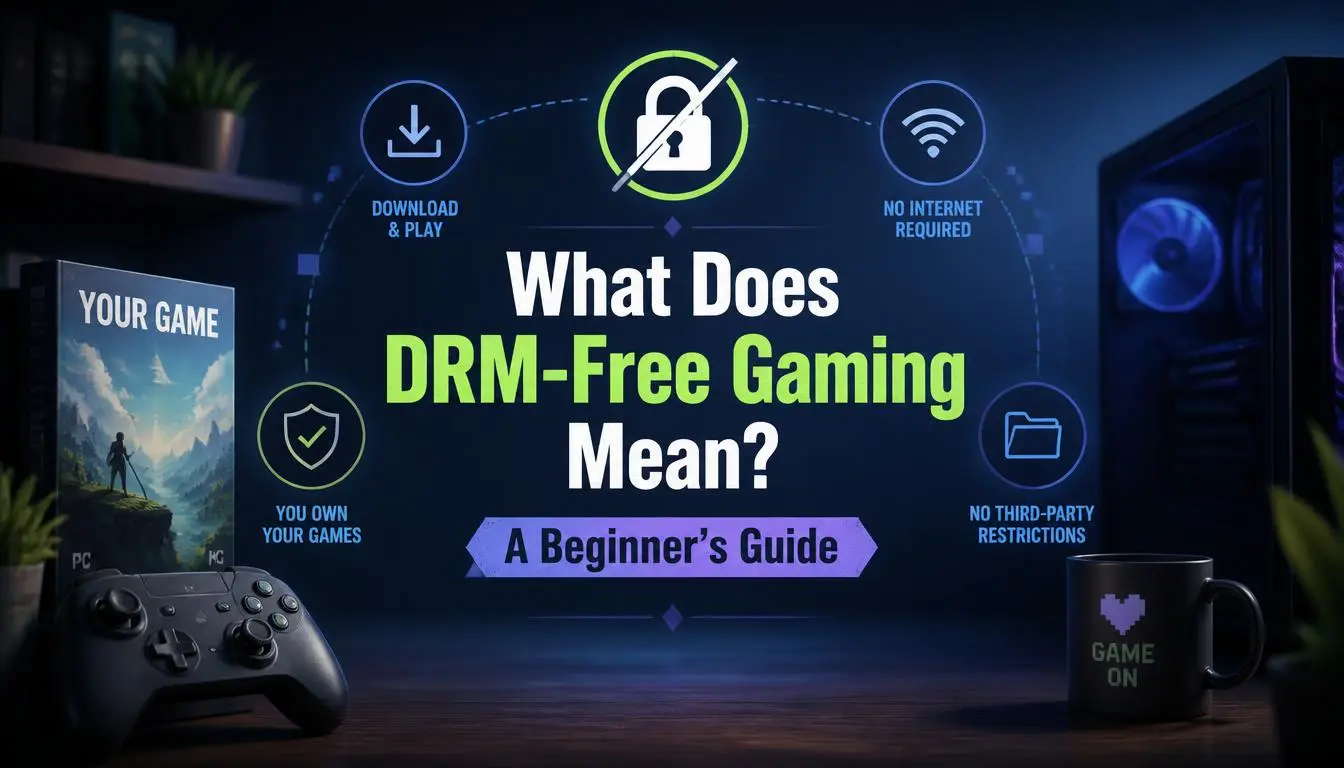
DRM-free games are those that allow users to play games without having to undergo DRM requirements that limit access to games. To put things simply, what does DRM-free gaming mean, and what does it mean for a player to have DRM-free games? It normally implies that you can be able to download and play a game that is supported by your system without the need for any additional ownership verification, online login, or the use of any third-party application in the process of playing the game. The game's own licence, multiplayer services, and technical requirements still matter.
Top Summary
The point is that the lack of DRM does not relate to taking out the copyright or providing you with full ownership of the game. This guide will be helpful to those who are just starting to play on PCs, to casual gamers, and to those who purchase digital games and want to understand what they buy. It is also worth reading if you are interested in playing games offline, using launchers, playing games without an Internet connection, or if you want to keep your games accessible for more time. I will describe what DRM-free gaming is, the mechanism of DRM protection, the possible advantages of a DRM-free release, and its limitations. Please follow my tips before purchasing a game.
Main Points to Note:
Make sure you know the exact DRM requirements of the game before purchasing.
Just because the game is DRM-free does not mean that everything is available offline.
Check whether a launcher or account is required.
Look separately at multiplayer and other online features.
Do not confuse DRM-free availability with owning the copyright of the game.
Check official developer or retailer information for game-specific requirements.
If local installers matter to you, check whether they're actually provided.
DRM in gaming stands for Digital Rights Management. It is a general term for technologies used to manage access to digital content. In games, these systems can affect how you install, launch, or access a title.
In games, that control can take different forms. For example, a game can require you to log into a profile or register the purchased game online, use a certain launcher, or connect to some services. The process differs for each specific game.
And that's worth knowing because DRM isn't necessarily one identical system used by every publisher.
Look, if you're new to PC gaming, I'd think of DRM as a checkpoint. You might have bought the game, but the checkpoint can still ask you to prove that you're allowed to play it.
Some DRM systems can be barely noticeable. Others can become much more obvious when a game needs an internet connection or another application just to start.
So when people talk about how DRM affects gaming, they're usually talking about these access requirements and restrictions rather than whether the game itself is good or bad.
So, what does DRM-free gaming mean for a PC player? Basically, it means you can play a supported game without certain DRM checks or access restrictions getting in the way.
DRM-free gaming generally means the game doesn't use additional DRM technology to restrict access to its core content.
That can mean no repeated ownership checks. It can also mean you don't have to keep a separate client running just to launch the single-player game, depending on the specific release.
But here's where I think the definition gets a little messy.
“DRM-free” doesn't necessarily mean “the entire game works without the internet.” DRM-free is about removing DRM restrictions; it's not a promise that every online feature suddenly becomes offline.
So, if you're looking at DRM-free gaming explained in the simplest possible way, think about access rather than ownership.
You may be able to download the game, install it on your PC, and launch the core game without an external DRM check. But you could still need the internet for multiplayer, cloud saves, updates, or other connected features.
That's an important distinction for beginners.
Explore DRM-free PC games and enjoy unlimited games as much as you like.
How Does DRM-Free Gaming Work?
For most players, the process is pretty straightforward:
Buy → Download → Install → Play
You buy a game from a retailer or developer, download the available files, install them, and then launch the game.
With a DRM-free release, there isn't an additional DRM system constantly checking whether you're authorised to start the game. Some DRM-free PC game stores also provide standalone installation files that you can keep locally.
And this is where offline gaming becomes relevant.
You still need the internet to purchase and download a digital game in the first place. You'll probably also need it for updates, multiplayer, or cloud-based features.
But once the relevant files are on your computer, a supported single-player DRM-free PC game may not need an online ownership check every time you play it.
I think of it like keeping a spare key in your own drawer. You still have to get the key somehow, but once you've got it, you don't have to phone someone every time you want to open the door.
That's not a perfect technical analogy, obviously. But it makes the basic idea easier to picture.
DRM-Free vs DRM-Protected Games: What's the Difference?
The easiest way to understand the difference is to look at what happens between installing a game and actually playing it.
Feature
DRM-Free Games
DRM-Protected Games
DRM ownership check
Generally not required for the core game
May be required
Offline single-player play
Often supported, depending on the game
Depends on the DRM and game
Separate launcher
May not be needed
May be required
Online authentication
Generally avoided for the core offline experience
May be required
Local installation files
Often available with DRM-free releases
Depends on the retailer
Multiplayer
Can still be available
Can still be available
Cloud saves
Depends on the game
Depends on the platform/game
Updates
Still require internet access
Still require internet access
So, does this mean DRM-free is automatically better? DRM matters on how you play. If you mostly play single-player games on a laptop while travelling, offline access might be a big deal. If you mainly play online multiplayer games with friends, you may care more about the platform's multiplayer and social features.
That means you shouldn't judge a game simply by its store platform. Check the actual game.
There are a few practical benefits of DRM-free games, particularly for people who don't want their single-player gaming experience tied closely to an online service.
Easier offline access
This is probably the biggest reason people look for DRM-free games.
If the game supports offline play without DRM authentication, you can potentially play it while travelling, during an internet outage, or somewhere with a poor connection.
Fewer launcher requirements
Some gamers don't want to open another application just to start a game.
A DRM-free release may allow you to launch the game directly from its installed files, depending on how that particular release has been packaged.
More control over local files
Some DRM-free PC game stores provide standalone installers, which can be useful if you want to keep legitimate installation files on your own storage.
DRM-free approach includes the ability to back up game files and play supported single-player games offline.
Useful for long-term access
This is another reason people care about DRM-free releases.
If you've downloaded legitimate installers and don't need an online client to launch the game, you may have fewer dependencies on a particular service. But operating systems change, hardware changes, and old software can develop compatibility problems.
A simpler single-player experience
For some people, it's just about convenience. And I get that.
If I've already bought a single-player game, I'd rather not deal with another login or ownership check every time I want to play it.
A game can be DRM-free and still rely heavily on online services.
Multiplayer is the obvious example. If you're playing against other people online, you'll need an internet connection regardless of whether the single-player portion uses DRM.
Cloud saves are another one. If your saved games are being synchronised through an online service, you'll need that service when you want to sync them.
And updates still need a connection.
A DRM-free game can also include features that depend on external servers, accounts or online content. That doesn't necessarily contradict the DRM-free label; it depends on what the developer or retailer means by DRM-free and what parts of the game are being discussed.
Wait, that's not quite right if I make it sound like DRM-free games always have fewer features. They don't.
A DRM-free game can still have multiplayer, achievements, downloadable content, and other modern features. Those features just aren't necessarily part of the DRM question.
So I'd avoid one big assumption: DRM-free doesn't guarantee permanent access, unlimited compatibility, or that every feature will work offline.
It tells you something much narrower and more useful: how the game handles digital access restrictions.
Buying a DRM-free game doesn't normally mean you've bought the copyright to the game. You're still using software under the licence and terms that apply to your purchase. This is where game ownership and DRM often get mixed together.
Think of it this way: removing the lock from a door doesn't mean you suddenly own the whole house.
That's the analogy I keep coming back to because it makes the distinction pretty clear.
DRM controls technical access. Copyright controls rights in the creative work. A software licence sets out what you're allowed to do with the copy you've obtained.
So even if you can install and play a DRM-free game without an online authentication check, that doesn't mean you can legally redistribute copies or upload the game's files for other people to download.
And that's important if you're researching digital game ownership.
The exact legal rights can vary by jurisdiction and licence, so I wouldn't treat “DRM-free” as a legal ownership term.
For game-specific questions, I'd check the publisher's or retailer's current licence information rather than relying on a general definition.
Explore Kinguin discounts and purchase and sell items used in games, such as software licenses and video game keys.
When Should You Look for DRM-Free PC Games?
You should look for DRM-free PC games when you want games that are not connected to the internet, don’t have launcher restrictions, and give you more control over installation.
Audience
Why DRM-free may matter
Beginner PC gamers
Fewer access requirements can make the setup easier to understand
Casual gamers
Useful if you mainly want straightforward single-player access
Travelling gamers
Offline play can help when internet access is unreliable
Laptop gamers
Useful when you're away from a stable connection
Digital game buyers
Helps you compare access requirements before buying
Game collectors
Local installers may be useful for maintaining a personal library
Offline-focused gamers
Reduces reliance on repeated online authentication
So, when should you actually use this advice?
Check DRM information before buying a digital game, particularly if you travel, have unreliable internet, dislike mandatory launchers, or care about keeping local installation files.
If none of those things bother you, DRM may not be a major factor in your buying decision.
And that's fine.
Not every online and offline gaming decision needs to become a technical research project.
Check Lenovo codes and find deals on their laptop, computers, and desktops.
How to Check If a Game Is Really DRM-Free?
You can check if a game is really DRM-free by looking at the store details, developer notes, and user reports to see whether it needs a launcher, online check, or other DRM to run.
I'd check like this before buying.
1. Check the retailer's DRM information
Look for a clear statement about whether the game uses DRM and what that DRM actually requires.
2. Check whether a launcher is required
A digital game may still require a platform client to launch, even though you've downloaded it.
3. Look for online activation requirements
Check whether you need an internet connection during installation or the first launch.
4. Check multiplayer separately
Don't assume that DRM-free means multiplayer is offline.
It doesn't.
5. Check official developer or publisher information
For a specific game, I'd give the developer or publisher's current documentation more weight than an old article or forum post.
6. Check whether standalone installers are available
If keeping local installation files is important to you, find out whether they're actually provided.
7. Check what features work offline
Look beyond the basic label. Check single-player, cloud saves, achievements, multiplayer, DLC and other features individually.
So, what is DRM-free gaming in everyday terms? It means you're getting a game without additional digital rights management restrictions controlling access to the core experience.
If you're a beginner PC gamer, casual gamer, digital game buyer, or someone researching DRM-free games, don't stop at the label. Check what the game actually requires.
Look at offline access. Check the launcher. See whether multiplayer needs an internet connection. Find out whether local installers are available. And don't confuse technical access with copyright ownership.
But most importantly, match the game to the way you actually play.
If you travel a lot or have unreliable internet, DRM-free access could be particularly useful. If you mainly play online with friends, it might not be nearly as important.
In simple terms, DRM-free gaming explained as technical support. All you have to do is know what you're buying and what you'll need to play it.
Check Air Gaming discount codes for gaming peripherals and accessories!
DRM in Gaming refers to Digital Rights Management, and it is a procedure that is used to manage and control digital games in order to ensure that they do not get pirated. In short, DRM means that one needs to prove that he or she owns the game, log in to their accounts, and even launch from specific launchers.
Gaming without DRM basically means playing a game without software that checks or controls how you access it. You can download and install the game normally, then start playing without going through an online ownership check or using a separate launcher to get it running.
DRM may influence gaming by placing certain restrictions on access to the game. For example, you might need an internet connection, an account, or a specific launcher before you can play. And if that service goes down or stops working, you could run into problems when trying to install the game or play it offline.
No, not in the sense of owning the game's copyright. It usually means the game doesn’t use DRM checks to restrict access after you get it. Your rights to copy, modify, or redistribute the game are still governed by the applicable licence and copyright rules.
Yes, most DRM-free single-player games can usually be played offline. That doesn’t mean you can do everything without internet. You’ll still need it for downloading the game, updates, multiplayer, cloud saves, etc. So, before buying, have a quick look at what the game actually requires.