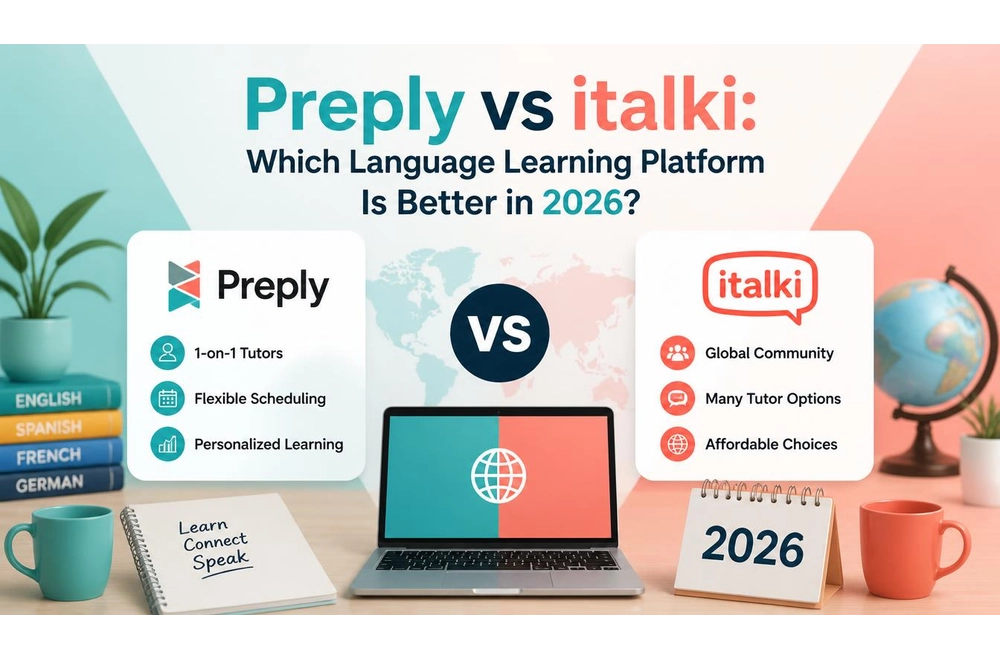
Preply vs italki: Which Language Learning Platform Is Better in 2026?
Published On
BY Haleema
About the Author
Haleema is a content editor specializing in online shopping, consumer research, and deal verification. She focuses on delivering accurate, up-to-date information that helps shoppers save money with confidence.
Deciding to learn a language with a real teacher instead of an app usually means Preply and italki are already open in two browser tabs. On the surface they look almost identical — browse profiles, read reviews, book a lesson, and repeat. But they price lessons, vet teachers, and structure your week differently enough that picking the wrong one tends to end one of two ways: you overspend, or you quietly give up once the scheduling gets annoying. This Preply vs italki comparison covers
pricing,
tutor quality,
languages,
scheduling,
and the overall learning experience so you can pick whichever actually matches how you learn.
Quick Summary
Preply vs italki in one line:
Preply is a subscription-based tutoring platform built for structured, weekly learning with built-in AI practice tools; italki is a pay-per-lesson platform built for flexible scheduling and a wider tutor pool, including rare languages.
Preply vs italki: Quick Comparison
Feature
Preply
italki
Best for
Structured tutoring
Flexible language learning
Number of languages
Wide selection
Wide selection
Professional tutors
Yes
Yes
Community tutors
Limited
Yes
Trial lessons
Available
Available
Mobile app
Yes
Yes
Self-paced learning tools
Built-in AI exercises and lesson summaries
Lighter — community forum and practice partners
Preply vs italki 2026 Overview
Preply Review
Online tutoring marketplace founded in 2012, connecting learners with tutors for one-on-one video lessons
No tutor tiers — everyone's in a single pool
Matching happens via an onboarding questionnaire plus filters (reviews, hours taught, student count)
Runs on a subscription model — you commit to a set number of lesson hours per week rather than buying lessons individually
Growth: raised $150 million in January 2026 at roughly a $1.2 billion valuation
Best fit: learners who want the AI-enhanced extras alongside live tutoring
If self-paced practice matters more than AI extras, compare against a straight course platform like Udemy — better suited to people who prefer working through video lessons alone rather than booking live tutor time
Both platforms let you read reviews, watch intro videos, and check a tutor's teaching history before booking, which is the baseline you'd expect from any serious online tutor platform in 2026. The real difference is structure. italki's professional-versus-community split gives you an upfront signal about qualifications before you even open a profile. Preply doesn't split its pool the same way — instead, it leans on its matching questionnaire and filtering system to steer you toward a good fit, which works well if you trust the algorithm but requires a bit more manual digging if you want to compare qualifications directly yourself.
Languages Available: Which Platform Offers More Choices?
Preply is strongest for widely spoken languages — English, Spanish, and French tutors are plentiful, with English alone reportedly drawing tens of thousands of tutors to the platform. italki generally wins on breadth for less common languages and regional dialects, since its open community-tutor model makes it easier for native speakers of smaller languages to start teaching without needing formal certification first. If you're after an online Japanese tutor for a mainstream course, either platform works. If you're after a specific regional dialect, italki is usually the better starting point.
Preply vs italki Pricing: Which Offers Better Value?
Pricing structure is where the two platforms diverge the most, not just the numbers themselves. On Preply, tutors set their own rates, typically landing between $15 and $25 per hour, though brand-new tutors building a profile sometimes start near $5. Because it's a subscription, you're committing to a set number of hours weekly whether or not your schedule cooperates that week. On italki, rates run wider — community tutors often sit around $4 to $15 per hour, while professional teachers with formal qualifications run $15 to $30 or more — and you're only ever paying for the credits you actually use, plus a small processing fee of roughly 4% on each credit purchase. For anyone whose schedule shifts often, italki's pay-as-you-go structure is generally the more forgiving option financially. For anyone who wants a predictable weekly routine and doesn't mind committing in advance, Preply's subscription can work out fine, as long as you're realistic about actually using the hours you're paying for.
Lesson Booking and Scheduling Compared
Preply's subscription model means you generally meet your tutor on a recurring weekly schedule, with 50-minute lessons as the default. You can reschedule with advance notice, but the structure assumes consistent weekly participation. italki works lesson by lesson — you book what you want, when you want, with multiple lesson-length options depending on the tutor. This is the single biggest practical difference between the two platforms: Preply rewards a consistent routine, while italki rewards flexibility for people whose weeks don't look the same twice.
Tools and Community
Learning Experience and Student Tools
Preply's classroom is built around structure — tutors create personalised lesson plans and learning paths, and the platform layers AI tools on top:
lesson summaries,
daily practice exercises,
and scenario-based speaking simulations designed to fill the gaps between live sessions.
italki takes a
lighter-touch approach,
offering a classroom space,
shared notes and materials from tutors,
and language-exchange features
that connect you with other learners rather than just AI-generated practice. If built-in structure between lessons matters to you, Preply's tools are more developed. If you'd rather practise with real people outside of paid lessons, italki's community leans further in that direction.
Community Features and Language Exchange
This is one of italki's clearest advantages. Its website has a community centre and language-exchange tools that allow you to interact with native speakers for informal practice, completely apart from paid classes. This is really helpful if you prefer informal talk over organised coaching as part of your learning method. Because its tools are based on paid tutoring rather than peer-to-peer practice, Preply does not provide a comparable free language-exchange community.
Mobile App and User Experience
Both platforms have mobile apps that mirror the desktop experience closely enough to book and attend lessons on the go. Preply's app follows the same layout as its website — manage your subscription, browse tutors, and join lessons — though some features are still a little smoother on desktop. italki's app supports its credit system and community features, including access to language partners and practice tools, alongside standard lesson booking. Neither app is a dramatic step down from the desktop experience, which matters if most of your practice happens on your phone.
Support, Value and Who Should Choose Which
Customer Support and Refund Policies
This is where user complaints cluster most consistently for Preply. Because lessons are tied to a weekly subscription, missing a scheduled week without enough notice can mean losing that lesson entirely, with no refund passed back to the tutor either – a policy that shows up repeatedly in user discussion as the main source of frustration. italki's pay-per-lesson structure sidesteps this specific problem since you're never locked into hours you didn't use. Both platforms offer trial lessons at a reduced rate before you commit to a full booking, which is worth using on both before deciding.
Preply vs italki: Pros and Cons
Platform
Pros
Cons
Preply
Structured lesson plans,
built-in AI practice tools,
strong for major languages
Subscription can penalise missed weeks;
less flexible scheduling
italki
Pay-per-lesson flexibility,
clear tutor tier system,
wider language and dialect coverage
Per-credit processing fee;
less built-in self-paced structure
Who Should Choose Preply?
Preply generally suits beginners who want more hand-holding — a set weekly routine, a tutor actively building a lesson plan around your goals, and AI tools reinforcing what you covered in the last session. If you know you'll actually show up every week and want that structure to keep you accountable, the subscription model works in your favour rather than against you.
Who Should Choose italki?
italki suits learners who want control — pay only for what you use, pick lesson length and frequency as it suits your week, and access a wider pool of native and community tutors, including for less common languages. It's also the stronger pick if your schedule genuinely varies week to week, since there's no subscription hours to lose if life gets in the way.
Preply vs. italki: Which Language Learning app Is Better in 2026?
Neither platform is objectively better — they're built for different learning styles, and the "right" choice depends on your schedule and how you like to learn.
Your Situation
Better Choice
Want a fixed weekly routine and accountability
Preply
Schedule changes often; need pay-as-you-go flexibility
italki
Learning a widely spoken language (English, Spanish, French)
both have strong coverage
Learning a rare language or regional dialect
italki
Want AI-powered practice tools between lessons
Preply
Want free peer-to-peer language exchange
italki
Tight, unpredictable budget
italki
If you value structure,
responsibility,
If you prefer integrated AI practice tools over flexibility, go with Preply.
If flexible scheduling,
a larger instructor pool,
and pay-as-you-go pricing are more important to you than a set weekly timetable, go with iTalki.
If you're still not convinced, you may try out both strategies before deciding on one because the sample lesson on both platforms is reasonably priced. Udemy discount codes on AnniePromo are worth checking if self-paced video courses better suit your learning style than live lessons for a more comprehensive look at online learning options beyond live tutoring. The Education category on AnniePromo covers more learning platforms and discount codes than just these two.
Key Takeaways
Choose Preply if: you want a fixed weekly routine, a tutor building a lesson plan around you, and AI-powered practice between sessions.
Choose italki if: your schedule changes often, you want to pay only for lessons you use, or you're learning a less common language.
Cheaper day-to-day: italki, since missed Preply weeks can mean lost, unrefunded hours.
Better for major languages: Preply and italki are roughly equal for English, Spanish, and French.
Better for rare languages: italki, due to its open community-tutor model.
Better for accountability: Preply's subscription structure.
Better for flexibility: italki's credit system.
The Bottom Line
Preply is the better fit for learners who want structure and are confident they'll show up every week.
italki is the better fit for learners who want control over cost, scheduling, and tutor type — especially for less common languages.
Neither platform is "better" outright — the right one depends on whether your priority is routine or flexibility.
Not universally, it depends on your learning style. Preply offers more built-in structure and AI practice tools, while italki offers more pricing flexibility and a wider tutor pool, especially for less common languages
It depends on usage. italki's pay-per-lesson credit system means you only pay for lessons you actually take, while Preply's subscription can cost more if you miss scheduled weeks. For consistent weekly learners, pricing tends to land similarly.
Not necessarily better — differently organised. italki clearly separates professional and community tutors upfront, while Preply relies on filters and a matching questionnaire across a single, larger tutor pool.
Yes, particularly through its community tutors, who offer lower-cost, less formal conversation practice. Beginners who want more structure and lesson planning may still prefer Preply.
italki generally covers more languages overall, especially smaller and regional dialects, thanks to its open community-tutor model. Preply has strong coverage of major languages like
English,
Spanish,
French.
and many others
Yes, both platforms offer discounted trial lessons before you commit to a full booking, which is worth doing on each if you're deciding between the two. If you're a student, it's also worth checking our guide to online student discount websites; language learning is rarely the only thing worth a discount code during study.