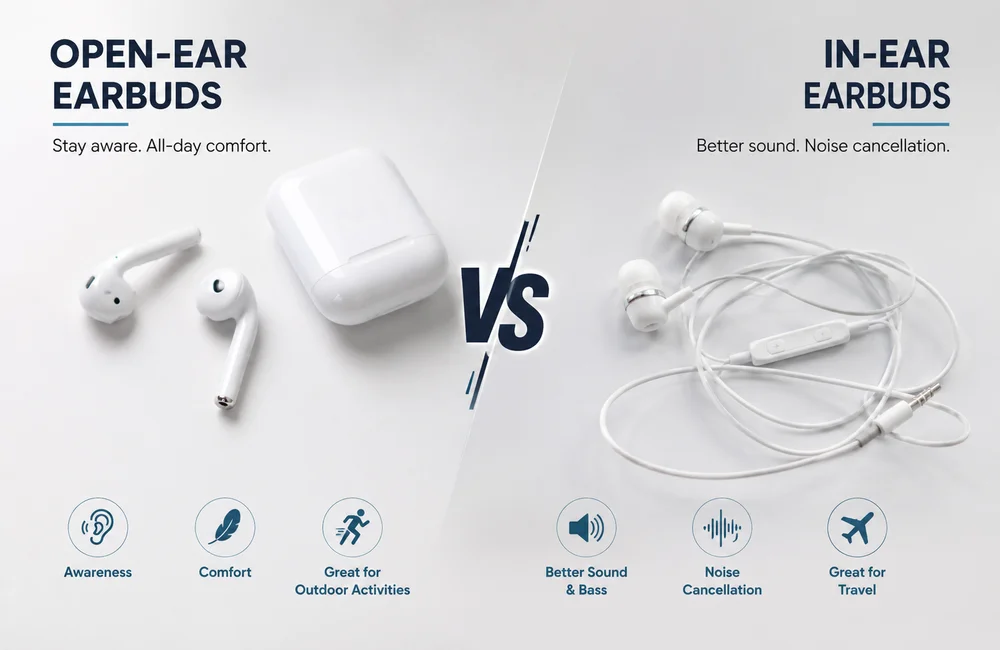
Quick Answer: Short version: in-ear earbuds still win on
raw sound quality
and noise cancellation,
since a sealed fit blocks outside noise and lets the driver push bass properly.
Open-ear earbuds win on
comfort,
awareness,
and long-wear situations,
running near traffic,
taking calls all day,
or just not wanting something jammed in your ear canal for eight hours straight.
Neither wins outright. It depends on whether sound isolation or situational awareness matters more to you. A few years ago, buying earbuds meant picking a color and a price point. Nearly everything sat inside your ear canal one way or another, so there wasn't much of a decision to make beyond budget. So open-ear earbuds vs in-ear earbuds isn't really about crowning one winner anymore; it comes down to how you actually use earbuds day to day.
This guide walks through the real differences: sound quality, comfort, battery life, noise handling, and which style tends to suit
If you want the full range of current earbud picks rather than a category comparison, our best wireless earbuds in Australia roundup covers specific models worth considering.
Top Summary
Open-ear and in-ear earbuds solve different problems rather than competing head-to-head on every metric. In-ear wins on sound quality, bass, and noise cancellation and are
Open-ear wins on comfort and awareness are
better for outdoor running,
all-day wear,
and situations where staying tuned in to what's happening around you matters.
The right choice comes down to matching the earbud style to how you'll actually use it, not chasing a single "best" pair.
Key Takeaways
In-ear earbuds seal the ear canal, giving stronger bass and better active noise cancellation
Open-ear earbuds, including bone-conduction models like Shokz, sit outside the ear canal and let ambient sound through
If you run or cycle, open-ear is usually the safer pick — you'll still hear traffic and people around you
Flying, commuting, or working in a noisy office? In-ear still does a better job blocking it all out
Long-wear comfort (six-plus hours) tends to favour open-ear, since there's no in-canal pressure buildup
Don't assume one style lasts longer on a charge — battery life comes down to the specific model, so check the actual spec before you buy
Who This Guide Is For
This one's for anyone stuck between two pairs of earbuds and not sure which style actually fits their life. Runners weighing up whether to ditch in-ear for something safer near traffic, office workers tired of ear fatigue after back-to-back calls, frequent flyers who want real noise cancellation, or just someone replacing a cheap pair and wondering if open-ear is worth the switch — this covers all of it. You don't need to know anything about drivers or bone conduction going in; by the end you'll know which camp you fall into.
What's Actually Different Between Open-Ear and In-Ear Earbuds?
Really it comes down to one question: does the earbud seal your ear canal shut or leave it open?
In-ear earbuds go inside the canal, usually with a silicone tip that forms a seal. That seal is doing two jobs — blocking outside noise passively (on top of whatever active noise cancellation the earbud has) and trapping bass so it hits harder, a bit like how a speaker in a closed cabinet sounds punchier than one sitting out in the open.
Open-ear earbuds skip that seal entirely. They sit near or around the ear instead of inside it. Shokz takes this the furthest with bone conduction — the earbuds never touch your ear canal, they send sound as vibrations through your cheekbone instead. Other open-ear designs use small speakers angled toward the ear opening without blocking it off.
Open-Ear vs In-Ear Earbuds: Side-by-Side Comparison
Factor | Open-Ear Earbuds | In-Ear Earbuds |
Sound quality | Good for mids/highs, weaker bass | Fuller sound, especially bass |
Noise cancellation | Minimal to none | Strong, especially with ANC |
Comfort for long wear | Very comfortable, no canal pressure | Can feel tight after hours of use |
Awareness of surroundings | High, you hear traffic, people, alarms | Low, especially with ANC on |
Best for | Running, cycling, office calls, commuting outdoors | Flights, gyms, blocking office noise, music focus |
Sweat/workout resistance | Generally good, no ear canal buildup | Good, but tips can loosen with sweat |
Price range | Mid to premium | Budget to premium |
Sound Quality: Does Sealing Your Ear Actually Matter?
It does, more than a lot of people expect. A sealed in-ear fit works almost like a small speaker cabinet — it contains the sound wave instead of letting it dissipate into open air, which is why bass response nearly always comes up as a clear in-ear advantage. As a result, open-ear designs typically sound thinner on bass-heavy recordings, but since they rely
If you're mostly listening to
If you want music to actually thump, in-ear or over-ear designs with a proper seal remain the stronger pick.
Comfort and Fit: Where Open-Ear Tends to Win
This is the category where open-ear genuinely pulls ahead for plenty of people. Even a well-fitted in-ear tip creates pressure inside the ear canal, and enough people find that uncomfortable after a couple of hours that "best earbuds for comfort" has become one of the more searched earbud-related terms going into 2026.
Open-ear designs remove that pressure entirely since nothing sits inside the canal. Bone-conduction models are particularly popular with anyone wearing earbuds for most of a working day — customer service reps on calls, remote workers stacking back-to-back meetings, or people who simply don't want something wedged in their ear from nine to five.
The trade-off shows up during high-movement activity. Some open-ear designs sit less securely during a sprint or a sharp head turn compared to a properly sealed in-ear tip, though current models have closed that gap a lot with better ear-hook designs.
Are Open-Ear Earbuds Good for Running?
yes, and it's one of the strongest cases for the category.
Running outdoors, especially near roads or shared paths, means being able to hear approaching
Open-ear earbuds pros and cons tip clearly towards open here — you keep full awareness while still getting your music or podcast.
Brands built specifically for this, design their open-ear, bone-conduction sports headphones around exactly this trade-off: leaving the ear canal open for safety while still delivering clear audio through the cheekbone. If running or cycling outdoors is your main use, it's worth checking a current Shokz discount code before buying, since it's one of the more established names built specifically for open-ear sports use.
Indoor gym workouts shift the calculation slightly, since you're not dealing with traffic awareness the same way. There it comes down more to personal comfort and whether sweat resistance and fit security matter more to you than ambient awareness.
Earbuds for Workouts: What Actually Matters
For general workouts such as
gym sessions,
home training,
For group classes,
the choice comes down less to safety and more to fit security and sweat handling. Worth checking regardless of which style you lean toward:
IP rating for sweat and moisture resistance (IPX4 minimum for regular gym use)
A fit secure enough to survive burpees, jumping, or fast direction changes
Battery life that comfortably covers your longest session plus a buffer
Quick-charge support if you're training daily and don't always remember to charge overnight
Grab a SoundCore discount code first if you go this route; there's usually one live. For the wider range of electronics beyond earbuds, our best online electronics stores in Australia guide is a useful starting point if you're kitting out a whole gym bag rather than just your ears.
Noise-Cancelling Earbuds: Where In-Ear Still Leads
If blocking out the world is the main goal — a loud office, a long-haul flight, a crowded train — in-ear earbuds with active noise cancellation are still the stronger option in 2026. ANC relies on a sealed fit; the earbud needs to physically block the ear canal before its microphones and processing can cancel ambient frequencies effectively. Open-ear designs can't really replicate this, since letting sound in is the whole point of the category.
This is the clearest dividing line between the two styles. If noise-cancelling earbuds are the priority, in-ear wins outright. If situational awareness is the priority, open-ear wins outright. There isn't much of a middle ground yet, though some hybrid designs are starting to bridge the gap with adjustable ambient modes.
Are Open-Ear Earbuds Good for Travel?
Depends on the type of travel. For flights, where blocking cabin noise and engine hum matters, sealed in-ear earbuds with ANC are the better pick — open-ear won't do much against a droning jet engine. For everyday travel — walking through airports, navigating a new city, catching public transport where you actually want to hear announcements — open-ear works well, since you're not cut off from your surroundings somewhere unfamiliar.
A practical setup a lot of frequent travellers land on is owning both: in-ear ANC earbuds for flights, and a lighter open-ear pair for everyday movement once they've landed. If you're also shopping for cases or accessories to protect either pair on the road, CASETiFY stocks phone cases and tech accessories worth a look, and a CASETiFY discount code can shave a bit off a travel tech kit.
Where to Find Earbud Discounts in Australia
Earbuds go on sale often enough that paying full price is rarely necessary, particularly around EOFY, Black Friday, and Boxing Day, when most audio and electronics brands run their steepest markdowns of the year. Before buying, it's worth checking:
Sign-up newsletters are worth using too, since first-order discounts on audio brands are common and easy to stack with a sitewide sale. For more general tactics on getting a code to actually work at checkout, our guide on how to find a coupon code that actually works covers this in more depth.
Best Wireless Earbuds by Use Case
Rather than naming one universal winner, here's a quick breakdown by what you're actually doing with them.
Use Case | Better Fit | Why |
Outdoor running or cycling | Open-ear (e.g. Shokz) | Keeps you aware of traffic and surroundings |
Long flights | In-ear with ANC | Blocks cabin and engine noise effectively |
All-day office calls | Open-ear | No ear canal fatigue over long hours |
Gym workouts | Either, prioritise fit and sweat resistance | Comfort and security matter more than style here |
Commuting on public transport | Open-ear or in-ear without ANC | Hearing announcements and surroundings matters |
Focused music listening | In-ear | Better bass and overall sound isolation |
Budget everyday use | In-ear (e.g., SoundCore, Bang Good) | Wide range of affordable options in this category |
Battery Life: Does Style Actually Change It?
Not as much as most people think. Whether the design is in-ear or open-ear has less of an impact on battery life than the
particular model
and battery capacity.
Many in-ear models fall into the same range, and many open-ear models run for six to eight hours on a single charge with a case that lasts much beyond a full day. Instead of assuming that one category will always outlast the other when comparing specific pairs, check the manufacturer's stated battery life directly.
Which Should You Buy?
If you're still deciding between which type of earbuds should you buy, a simple instinct check typically will settle it:
If you want to block out the world and care about deep bass? Go in-ear.
Want to stay aware of your surroundings and wear earbuds for hours at a stretch? Go open-ear.
Genuinely need both? It's increasingly common to just own a pair of each rather than hunting for one earbud that does everything well.
How We Researched Comparison
To help Australian buyers compare the characteristics of open-ear and in-ear earbuds, we collected the published specifications of this type of equipment. In addition, we studied the accompanying features described by manufacturers and analyzed which characteristics are most relevant for a particular customer, considering specific models.
Our comparison is based on third-party information rather than on research and personal testing. Since we do not have enough information about all earphones, the characteristics may vary for different models and owners. Therefore, before purchasing, study the description of a particular device, its water resistance level, battery performance, and warranty conditions.
You can also compare the available options for the Shokz discount code on our pages before purchasing. Also, pay attention to special offers and promotions that may be available on the day of purchase on the store’s page.
AnniePromo may receive a commission for referring traffic or business and will find out more information about the goods on the basis of personal research. Read our affiliate disclosure
Conclusion
The choice between open-ear vs in-ear earbuds comes down to how you plan to use them. Runners and all-day listeners often prefer open-ear models, while frequent flyers and bass lovers usually choose in-ear earbuds. If you're not sure which camp you fall into, think about where you'll actually be wearing them most, like
a busy street,
a quiet office,
a gym,
a plane
and let that decide it rather than picking on price or trend alone. Whichever direction you go, checking current Shokz, SoundCore, or Bang Good discount codes before checkout is an easy way to bring the cost down.