Jackery vs Bluetti vs EcoFlow: Portable Power Station Comparison 2026
Published On
BY Haleema
About the Author
Haleema is a content editor specializing in online shopping, consumer research, and deal verification. She focuses on delivering accurate, up-to-date information that helps shoppers save money with confidence.
Jackery vs Bluetti vs EcoFlow is the comparison almost every buyer runs into once they start shopping for a portable power station.
Quick answer:
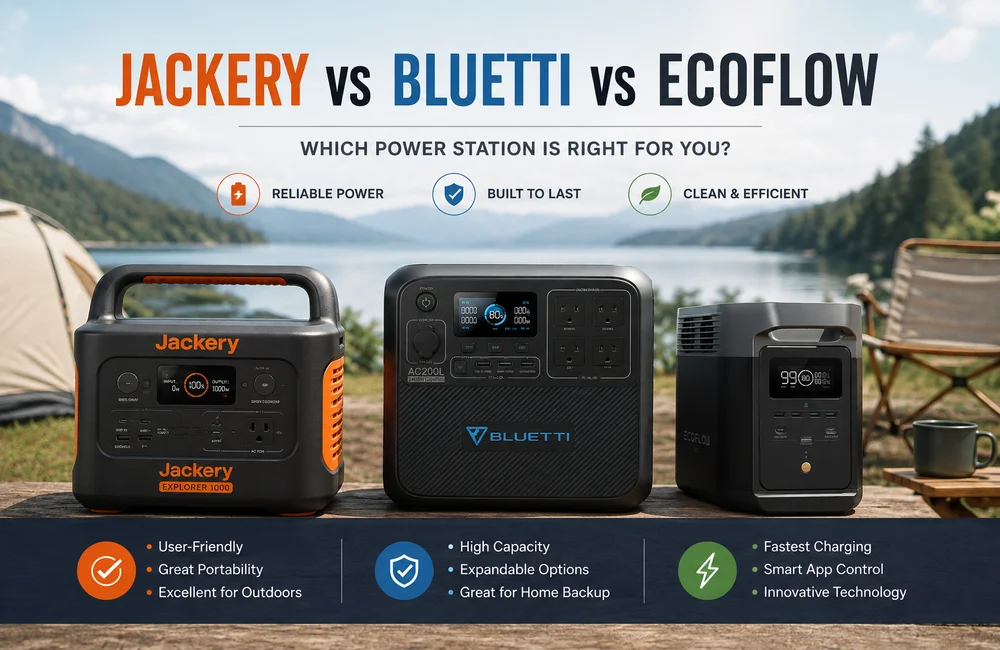
EcoFlow usually wins on charging speed and app polish, Bluetti leads on solar input and expandable capacity, and Jackery takes portability and outdoor build quality. Which one is actually best for you depends on whether you're powering a campsite, a van, or a whole house during an outage.
This comparison looks at specifications, battery chemistry, pricing, and customer feedback across all three brands' current lineups. It isn't a claim of hands-on testing of every unit. AnniePromo is a deals platform, not a product review lab, so what follows is a research-based breakdown pulled from published datasheets and aggregated owner feedback. The goal is to help you pick the right portable power station, not to sell you on one brand over another.
Portable power stations have gone from niche camping gear to a genuine home backup option in the space of a few years. Jackery, Bluetti, and EcoFlow are the three names that come up in almost every conversation about which one to buy. Here's how they actually stack up.
How This Comparison Was Put Together
This breakdown draws on each brand's published spec sheets, current Australian pricing, warranty documentation, and a read-through of recurring themes in owner reviews and forum discussion – the kind of feedback that shows up repeatedly across hundreds of buyers rather than a single anecdote. Where a brand makes a specific claim, like EcoFlow's sub-10-millisecond UPS switchover time, that's checked against the brand's own published specifications rather than taken at face value.
Solar Generator Comparison at a Glance
Before the deep dive, here's the short version of this solar generator comparison for anyone skimming:
Priority
Best Pick
Why
Fastest charging
EcoFlow
X-Stream tech, 0–80% in under an hour on most models
Solar input and expansion
Bluetti
Widest solar voltage range, easiest to chain into a bigger system
Portability and camping
Jackery
Lightest units, most developed outdoor accessory ecosystem
Home backup with UPS switchover
EcoFlow
Near-instant switchover on flagship models, keeps electronics running through outages
Budget-conscious, mid-capacity
Bluetti
Strongest price-per-Wh in the mid-range segment
Jackery vs Bluetti vs EcoFlow: Full Spec Breakdown
Five factors decide most buying decisions between these three brands: battery chemistry, charging speed, solar input, physical build, and warranty. Here's each one on its own.
Battery Chemistry and Lifespan
Battery chemistry, not wattage, is the single biggest factor separating these three brands in 2026. Most current-generation models across Jackery, Bluetti and EcoFlow have moved to LiFePO4 (lithium iron phosphate), rated for roughly 3,000+ charge cycles to 80% capacity. Older or budget-tier units — some Jackery Pro-series models included — still run NMC lithium, which tops out closer to 800–1,000 cycles.
In practical terms, a LiFePO4 unit charged daily can realistically last close to a decade before capacity noticeably drops. An NMC unit covers roughly a third of that.
If you're comparing a specific model rather than a brand as a whole, checking the battery chemistry on the spec sheet matters more than checking the logo. A newer Jackery Plus or v2 model with LiFePO4 will outlast an older NMC unit from any brand, Jackery included.
Jackery vs EcoFlow: Charging Speed and Power Output
This is where EcoFlow tends to separate itself. EcoFlow's X-Stream charging technology can take some models from 0–80% in under an hour from a wall outlet, according to EcoFlow's official Australian product pages.
Comparable Jackery units usually take two to four hours for the same job, though Jackery's newer v2 series has closed some of that gap. For anyone who needs to top up quickly between outings, or who's riding out a rolling blackout with only short windows of grid power, that charging speed difference is the whole ballgame.
Jackery's counter-argument is build quality and simplicity. Its units are lighter across most comparable capacities, the app is cleaner (if less feature-rich), and the outdoor accessory ecosystem — carry cases, solar panel mounts, camp lighting — is more developed than EcoFlow's, since Jackery's been building specifically for campers and hikers for longer.
Bluetti vs EcoFlow: Solar Input and Expandability
Bluetti's case is less about speed and more about scale. Several Bluetti models accept a wider solar voltage range and higher maximum solar wattage than equivalent EcoFlow or Jackery units, which matters if you're running a serious panel array rather than a single foldable panel.
Bluetti also leads on modular expansion. Its battery packs are usually the easiest to chain together for building a larger capacity system over time — a big deal for van life setups and home backup builds that need to grow.
EcoFlow isn't far behind on expandability, particularly with its DELTA Pro line. Bluetti's ecosystem is still the one most often cited as the most flexible of the three for building toward a genuinely large off-grid system rather than buying one unit and being done.
Jackery vs Bluetti: Portability and Build Quality
Put a Jackery and a Bluetti side by side and the design philosophy shows immediately. Jackery leans into hiking and camping — rugged cases, strong handles, lighter overall weight for a given capacity. Bluetti leans boxier and more utilitarian, built more with a garage or a van setup in mind than a hiking pack.
Neither is wrong; they're just solving different problems. If the unit's spending most of its life being carried to a campsite, Jackery's design choices matter more. If it's living in a van or a shed and getting wheeled out during an outage, Bluetti's sturdier, more expandable build tends to be the better fit.
If you're pairing a power station with the rest of a camping or 4WD setup, it's worth browsing BCF or Snowys for the tents, coolers, and camp kitchen gear that go alongside whichever unit you land on.
Warranty and Long-Term Support
Warranty coverage is where the three brands genuinely diverge, and it's worth checking before you buy rather than after something breaks. EcoFlow leads here on paper, with most current RIVER and DELTA-series models carrying 5-year coverage.
Jackery's standard warranty sits lower, typically 2 to 3 years depending on the model, with only select premium units stretching further. Bluetti varies the most of the three — some entry models carry shorter coverage while others in the AC and Elite ranges stretch to 4 to 6 years, so it's a model-by-model check rather than a brand-wide guarantee.
Owner-reported experience broadly tracks the warranty picture too. Jackery sees the fewest complaints about unexpected failures in forum discussion, EcoFlow's support is rated fastest to respond, and Bluetti's product quality is usually rated well even though its support response time gets flagged as the slowest of the three among owners.
EcoFlow's company history is worth a glance too — founded in 2017, it's the youngest of the three, which partly explains its faster iteration on charging technology.
Pros and Cons of Jackery, Bluetti, and EcoFlow
Store
Pros
Cons
Jackery
Easy to use, lightweight, reliable, great for camping and travel.
Fewer expansion options. Slower charging than EcoFlow. Higher price for some models.
Bluetti
Long battery life, expandable capacity, great value, ideal for home backup.
Larger models are heavier. App can be basic. Higher upfront cost on premium models
EcoFlow
Very fast charging, powerful output, smart app, expandable system.
Premium models are expensive. Fans can be noisy while charging. Some accessories cost extra.
Best Portable Power Station by Use Case
Battery specs matter less once you know what you're actually using the unit for. Here's how the three brands sort by use case.
Best Portable Power Station for Camping
For camping specifically, the deciding factors are usually weight, solar plug-and-play simplicity, and how well the unit pairs with a portable panel. Jackery's ecosystem is the most polished here — panels and units are designed together, setup tends to be simple, and the lighter overall weight matters more when you're the one carrying it.
EcoFlow's compact RIVER-series units are a reasonable alternative if charging speed matters more than ecosystem polish, since a quick top-up from a campsite power point (where available) can beat waiting on solar alone. If you're building out a full camping kit rather than shopping power stations in isolation, our camping gear essentials guide for Australia covers the rest of what's worth packing, and Cosy Camp or Wild Earth are both worth checking for camp furniture and outdoor accessories.
Best Portable Power Station for Home Backup
Home backup changes the priority list. Capacity and expandability matter more than portability, and recharge speed matters more than weight, since a fast wall recharge means catching a brief grid restoration during a longer outage. This is where EcoFlow and Bluetti both have a real edge over Jackery — EcoFlow on raw recharge speed and near-instant UPS switchover, Bluetti on the ability to add capacity over time rather than buying a bigger single unit upfront.
For a household building toward whole-home backup rather than just keeping a fridge running for a night, Bluetti's modular systems usually offer the better long-term cost per added kilowatt-hour.
Best Solar Generator and Most Powerful Solar Generator
"Solar generator" is really just a portable power station paired with solar panels. The most powerful solar generator setups in 2026 tend to come from whichever brand accepts the highest solar wattage input alongside the largest battery capacity.
Bluetti leads on maximum solar input among the three, which matters if you're running a genuinely large panel array rather than a single fold-out panel. EcoFlow's flagship DELTA Pro-class units aren't far behind and pair that with the fastest wall-charging speed of the three. Jackery's higher-capacity Explorer models are capable but sit a step behind both on raw solar wattage ceiling.
Portable Power Station Australia
Buying locally changes a few things, from which climate suits which brand to when the best sale windows land.
A Note for Australian Buyers
All three brands ship and sell directly across Australia, so it comes down to climate and use case, not availability.
Up north with consistent sun? Bluetti's wider solar input makes a bigger panel setup more worthwhile.
Storm-season blackouts in Queensland or northern NSW? EcoFlow's fast recharge and UPS switchover get you back up before the next outage.
Weekend camping or 4WD trips? Jackery's lighter units are easier to lift in and out of the boot.
Hold off on full price. EOFY and Boxing Day are when all three run their biggest Australian sales, so check AnniePromo for a current code first.
Pricing and Availability
All three brands sell directly to Australia along with stockists carrying current-generation models, and pricing scales with capacity rather than brand. A 1,000Wh-class unit from any of the three sits in a broadly similar price bracket, with the real spread showing up at the higher-capacity end.
Since these aren't small purchases, it's worth checking for a current discount code before buying rather than paying full list price, particularly around EOFY and Boxing Day sale periods when all three brands tend to run their deepest markdowns of the year. AnniePromo tracks current codes for EcoFlow, Bluetti, and Jackery directly, and our guide on how to find a coupon code that actually works is worth a read if a code isn't applying at checkout.
Jackery Explorer vs Bluetti AC Series: Head-to-Head
The Jackery Explorer line and Bluetti's AC series are the two ranges most people cross-shop directly, since they overlap heavily on price and capacity. Broadly: Explorer units are lighter and better suited to being carried, with a more polished companion app for basic monitoring. Bluetti's AC-series units tend to accept more solar input and offer better expansion options, at the cost of being bulkier and slightly heavier for the same capacity. If portability is the priority, Explorer generally wins; if you're building a system that needs to grow, the AC series usually makes more sense.
Comparison Point
Jackery Explorer Series
Bluetti AC Series
EcoFlow DELTA/RIVER Series
Charging speed
Moderate to fast (v2 models improved)
Fast, wide solar voltage range
Fastest, X-Stream tech
Solar input capacity
Good, smaller ecosystem
Highest among the three
Strong, close second to Bluetti
Portability
Lightest, hiking-focused design
Bulkier, utilitarian build
Mid-weight, compact RIVER line
Expandability
Limited on most models
Best modular expansion
Strong, particularly DELTA Pro
Battery chemistry
Mixed check model (NMC on older units)
Mostly LiFePO4
Mostly LiFePO4
Best suited for
Camping and hiking
Home backup, van life systems
Fast recharge, general all-rounder
If a van or caravan setup is the end goal rather than a single power station purchase,Caravan RV Camping is worth a look for the rest of the fit-out.
Which Is the Best Portable Power Station Overall?
There's no single best portable power station for every buyer, and any comparison that claims otherwise is oversimplifying. The honest answer depends on what you're optimising for:
Buy Jackery if portability and a polished outdoor ecosystem matter most — campers and hikers get the most out of the Explorer line, and it's a strong pick if you want the best portable battery generator for weekend trips rather than a home backup system.
Buy EcoFlow if charging speed is the priority, particularly for home backup where catching a short grid-restoration window matters.
Buy Bluetti if you want the most expandable system, or you're building toward a larger off-grid or home backup setup over time.
Jackery wins on portability and outdoor build quality — best for camping and hiking.
EcoFlow wins on charging speed, app polish, and UPS switchover — best for fast home backup recharge.
Bluetti wins on solar input and modular expansion — best for van life and growing home backup systems.
Most current models across all three brands now use LiFePO4 batteries (3,000+ cycles), though some older Jackery units still run NMC (800–1,000 cycles).
Warranty coverage varies by model, not just brand — EcoFlow offers the longest standard coverage as a rule, Bluetti the widest range.
Check AnniePromo for a current EcoFlow, Bluetti, or Jackery discount code before buying — pricing scales with capacity, not brand.
Key takeaway: If you're deciding between Jackery, Bluetti, and EcoFlow, pick Jackery for camping, EcoFlow for fast home backup, and Bluetti for a system you plan to expand over time.
Conclusion
There's no single winner in the Jackery vs Bluetti vs EcoFlow debate, and that's really the point: each brand built its lineup around a different priority.
Jackery is the pick for camping and hiking, where weight and a polished solar ecosystem matter more than raw specs. EcoFlow makes the most sense for home backup, since its fast charging and near-instant UPS switchover mean catching a grid restoration that a slower unit would miss. Bluetti is the one to look at if you're building toward a larger system over time, whether that's a van life setup or whole-home backup, thanks to its stronger solar input and modular expansion.
Rather than asking which brand is best overall, it's worth asking what you're actually optimising for — portability, speed, or scale. Whichever one you land on, it's worth comparing current pricing and checking for a live discount code before buying, since EcoFlow, Bluetti, and Jackery all run meaningful sales around EOFY and Boxing Day.
Jackery vs Bluetti vs EcoFlow is the comparison almost every buyer runs into once they start shopping for a portable power station. EcoFlow usually wins on charging speed and app polish; Bluetti leads on solar input and expandable capacity; and Jackery takes portability and outdoor build quality. The best portable power station for you depends on whether you're powering a campsite, a van, or a whole house during an outage. This Jackery vs Bluetti vs EcoFlow comparison walks through specs, battery chemistry, pricing, and customer feedback across all three current lineups — you'll find current codes for each brand, along with more deals across every category, at AnniePromo. built to help you pick the right portable power station rather than to sell you on one brand over another.
EcoFlow generally wins on charging speed and app features; Jackery wins on portability and outdoor build quality. Campers tend to prefer Jackery, while home-backup buyers often lean EcoFlow for the faster recharge.
Bluetti's stronger solar input and modular expansion make it a common pick for larger home backup builds, while EcoFlow's faster charging suits shorter, more frequent outages. Both are reasonable choices depending on how you plan to expand the system over time.
Jackery is lighter and more camping-focused with a more polished outdoor accessory ecosystem. Bluetti is bulkier but accepts more solar input and expands more easily, making it a better fit for van life or home backup systems that need to grow.
Jackery's Explorer line is generally considered the strongest camping option thanks to its lighter weight and integrated solar panel ecosystem, though EcoFlow's compact RIVER series is a solid alternative if fast recharging matters more.
Bluetti and EcoFlow both edge out Jackery here — Bluetti for expandable capacity, EcoFlow for faster recharge speed during short outage windows.
Yes, all three brands sell directly to Australian customers, with current-generation models generally available through their own stores and select retailers.